
History
Achiote, whose scientific name is Bixa orellana, is a species of tree or shrub native to tropical regions of the Americas. It is called urucum in Brazil, achiote in Mexico and several South American countries, or onoto in Venezuela, and is sometimes referred to as the “lipstick tree.” Its name comes from the Tupi language, spoken by Indigenous peoples of Brazil, who called it urucu.
Achiote originates from northern Brazil, in the Amazon rainforest, and is believed to have arrived in Martinique through the migrations of Indigenous peoples (Arawaks/Caribs) at an unknown date.
Varieties
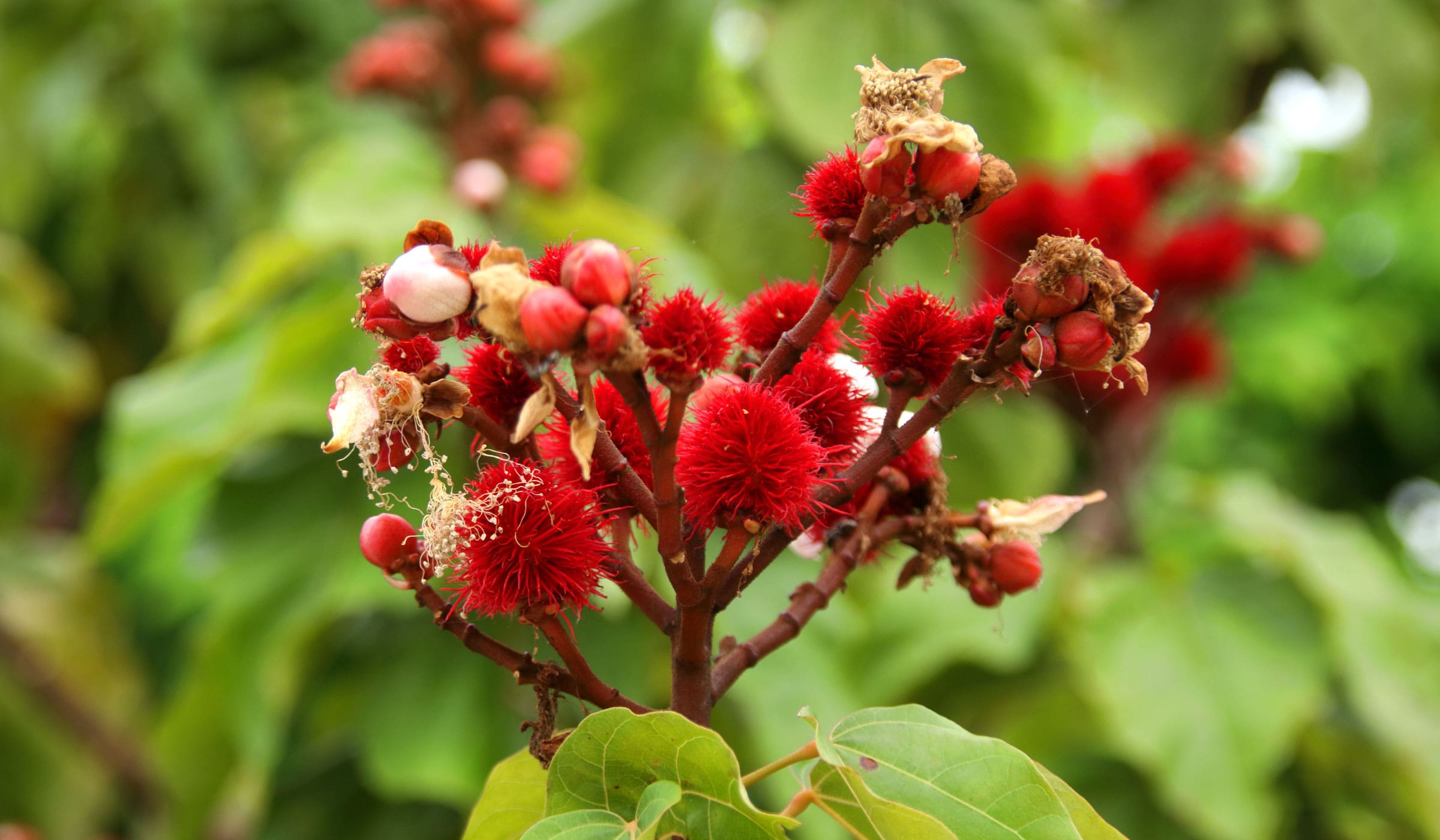
There is only one variety of annatto. The tree, known as the annatto tree or achiote tree, is a shrub that typically grows to a height of 2 to 4 meters. Its leaves are cordiform (heart-shaped), pointed, and serrated. The red fruit appears as a capsule and is not edible. It is harvested and then dried to extract the wax that surrounds the seeds, which are very rich in carotenoids.
An annatto tree can live for about 50 years, and its fruits can be harvested for 30 years. It takes 2 years before the tree begins to bear fruit. The clusters reach maturity up to 3 months after flowering. Harvesting begins when 2 or 3 capsules have opened.
Medicinal properties
Annatto is known for its anti-genotoxic and anti-mutagenic properties, as well as its protective effects against oxidative stress. It is an antioxidant.
However, it does present some toxicity. Annatto is an effective hemostatic agent for minor wounds. The substance surrounding the seed is often used as a cooling remedy and to reduce fever.
The crushed seed is said to be aphrodisiac. It is also known as a tonic for the gastrointestinal system and as an expectorant.
A decoction of the leaves helps soothe throat inflammation and mild tonsillitis. A leaf applied to the forehead relieves headaches. The root contains a digestive and diuretic compound.
Uses
In the past, Indigenous peoples used annatto as a pigment for body painting, as a seasoning, and also as protection against heat and sea salt.
Today, annatto is mainly used in cooking to add color to dishes prepared with sauce, especially court-bouillon. It is also used in the creation of beauty products and as protection against insect bites and the sun.


