
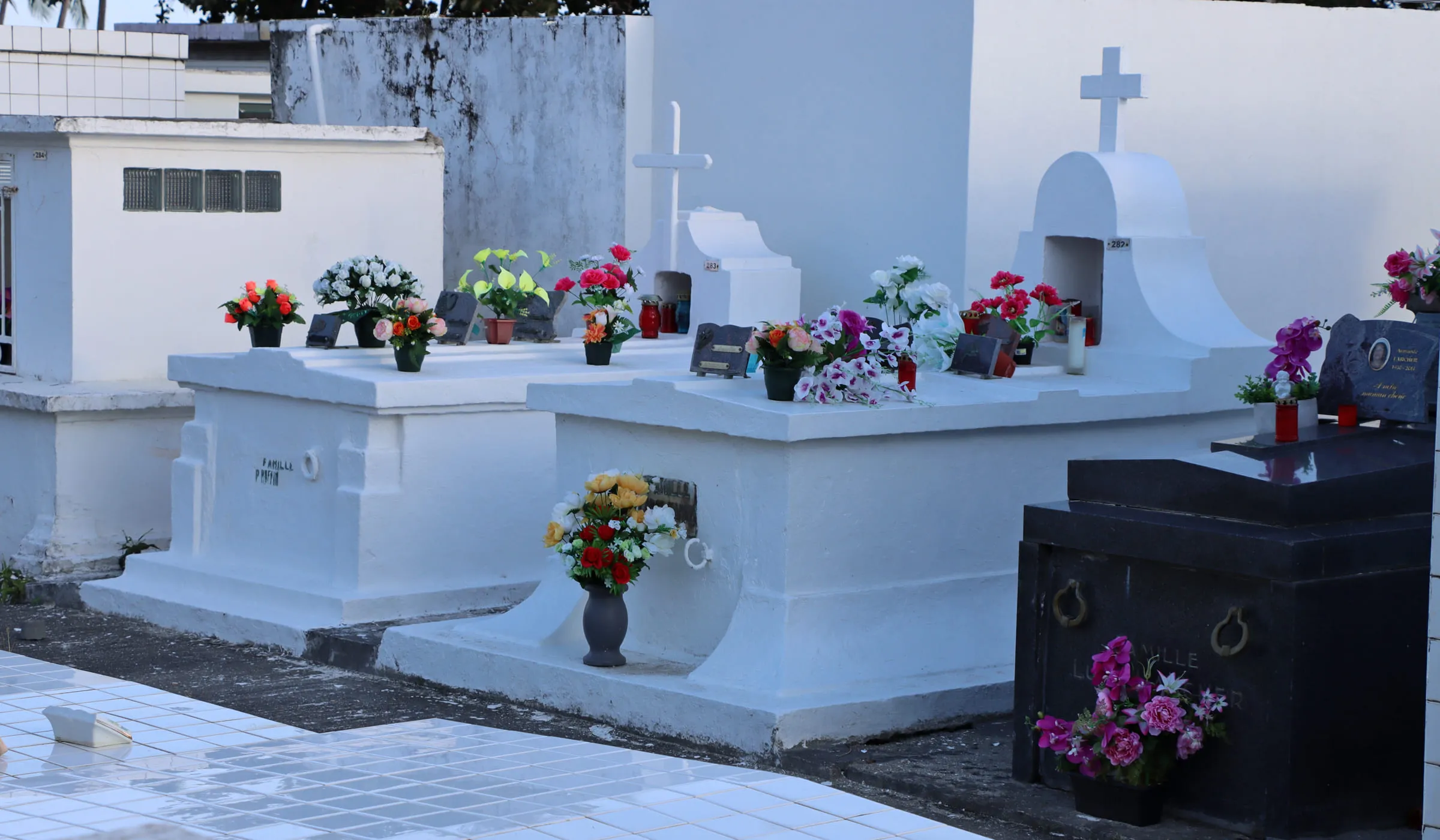
Martinique is very respectful of Christian holidays, given the high proportion of Christians (over 90% of the population) on the island. All Saints' Day is a very important holiday in Martinique. While in France, All Saints' Day is celebrated only on November 1st, in Martinique, two days are dedicated to it. Both days—November 1st and 2nd—are public holidays.

There is no notable difference in the way the two days are observed. Like all major Christian holidays (Easter, Pentecost, and Christmas), All Saints' Day is prepared collectively and in advance.
For several decades, All Saints' Day has been an occasion to gather "large families" (extended family structures including grandparents, uncles, aunts, cousins, etc.) in cemeteries to recall the memories of departed loved ones. Previously, in the days leading up to November 1st, children were given brushes, brooms, and cleaning products by their parents to clean the family graves. The parents would then do the necessary work and repaint the graves. In the last two decades, things have changed somewhat.
Young people in the vicinity of cemeteries clean, repair doors and windows, and repaint graves in exchange for small sums. In Martinique, graves are traditionally painted white, and entire cemeteries are often whitewashed. The use of white in mourning and death likely stems from the heritage of former slaves who wore white at funerals to honor departed loved ones. White symbolizes the resurrection of the body. Today in Martinique, people wear both white (representing resurrection, a tradition rooted in African culture) and black (symbolizing sadness, death, and finality, a tradition from Europe) during funerals.
The days leading up to All Saints' Day mark the annual period of major cemetery cleaning, bringing unusual activity to places usually steeped in silence. Once the graves are cleaned, they are adorned with flowers on the days just before or on the eve of All Saints' Day. However, while cemeteries may be bustling, the surrounding neighborhoods remain calm. The atmosphere is not festive; family gatherings are discreet and modest. In the past, it was unthinkable to host a party at home in the days preceding All Saints' Day.
Today, this silence and desired calm are increasingly rare, especially since the traditional "funeral atmosphere" was rooted in the fear of judgment from close neighbors. On the morning of All Saints' Day, families attend mass dressed in white, where the priest honors all the saints as is customary. Everyone wishes one another a happy feast day, as this day celebrates all the saints—and, by extension, all names.

At nightfall, families go to the cemeteries where their loved ones are buried, bringing candles to illuminate the graves. Contrary to what one might think, these gatherings are not somber occasions. While in metropolitan France the atmosphere is one of peaceful silence, in Martinique, All Saints' Day is a time when smiles and good humor fill the cemeteries. Family members who have not seen each other for a long time recall fond memories shared with the deceased.
It is a moment to reconnect with a distant cousin who had faded from view, to encounter a former classmate paying tribute to a loved one, or to catch up with an elderly aunt and promise a visit soon. Beyond the reunion, which is rooted in family exchange and carries a strong social dimension, it is also a more “historical” moment—marked by the transmission of knowledge, culture, and history between generations.
Grandparents tell the younger generation how All Saints' Day was celebrated in their time, in the time of their parents, or even their grandparents. While the adults chat, the children take advantage of the moment to play and run around the cemetery, often playing hide-and-seek. After a few hours of family reunion, everyone leaves, promising to meet again soon. Most of the time, these promises are only fulfilled at the cemetery gates, with the next All Saints' Day becoming the occasion to reunite.
The only difference between November 1st and 2nd lies in the content of the mass. On November 2nd, the priest celebrates a mass focused more on the deceased. This is known as the "Mass of the Dead." Unlike other religious holidays that feature specific meals, All Saints' Day has no traditional dish associated with it.
Martinique is very festive! Don’t be surprised to hear the first sounds of drums and choirs singing Christmas carols the very next day!