History
The eggplant, whose scientific name is Solanum melongena, is an herbaceous vegetable plant belonging to the Solanaceae family. It is cultivated for its fruit, which is eaten as a vegetable. The term “eggplant” refers to both the plant and its fruit.
Today, it is impossible to state with certainty that the eggplant originated from one specific region of the world. Its origins remain uncertain, particularly because the wild ancestor of the eggplant is suspected to come from Africa.
Otherwise, around 4,000 years ago, the earliest forms of eggplant cultivation—still very rudimentary—appeared in South Asia, especially in the Assam region and in Burma. Eggplant has been common throughout Asia for more than 2,500 years, where varieties of all colors can still be found today.
The eggplant later reached North Africa through Arab traders, well before the Middle Ages. At the beginning of the Middle Ages, it was introduced into Spain.
It arrived in France in the 14th century and was given the name Solanum melongena, meaning “bad but soothing apple.”
It reached Martinique during the colonial period, although the exact date remains unknown.
Varieties
There are several hundred varieties of eggplant. More than 320 varieties are listed in the Official Catalogue of Plant Species and Varieties, and more than 40 in the French Catalogue.
In Martinique, there are only two varieties: the Kalenda variety, which is a hybrid, and another purely local one called Madinina.
The plant is grown as an annual in temperate countries and as a perennial in tropical regions.
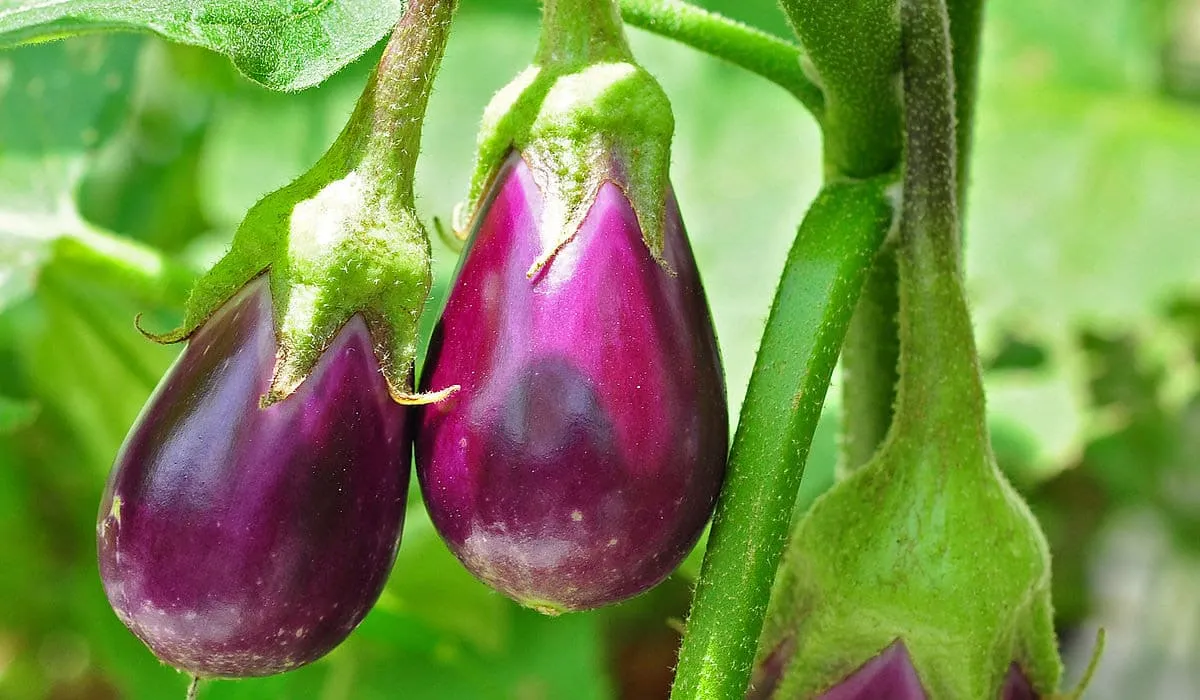
Its flowers, white or purple and solitary, grow in the leaf axils. The fruits come in various shapes (ovoid, pear-shaped, spherical, cylindrical, or very elongated) and in various colors (ivory white, yellow, green, and more commonly violet to almost black), either uniform, shaded, or striped.
Medicinal Properties
Thanks to its texture and flavor, eggplant is one of the most appreciated vegetables among people looking to reduce their meat consumption.
It is low in calories and contains a significant amount of dietary fiber.
This vegetable has strong antioxidant properties, especially its skin. The darker it is, the more antioxidants it contains. These antioxidants help protect the body’s cells and reduce the risk of cardiovascular diseases, cancers, and other age-related illnesses.
Uses
Eggplant is rarely eaten raw. It is most often cooked as a purée, in stuffed gratins (see photo opposite), or as fritters. It is essential in ratatouille.
However, if you want to benefit from its vitamins as much as possible, it is better to eat it raw, especially in salads.