
History
Soursop, whose scientific name is Annona muricata, originates from tropical America, more specifically Colombia. It spread throughout the Caribbean in the 17th century from the island of Curaçao, then called “Curasso” or “Corossol,” from which it kept its name. It is one of the first fruits Christopher Columbus introduced to the Old World.
Soursop thrives in warm, humid climates and well‑drained soil.
Varieties
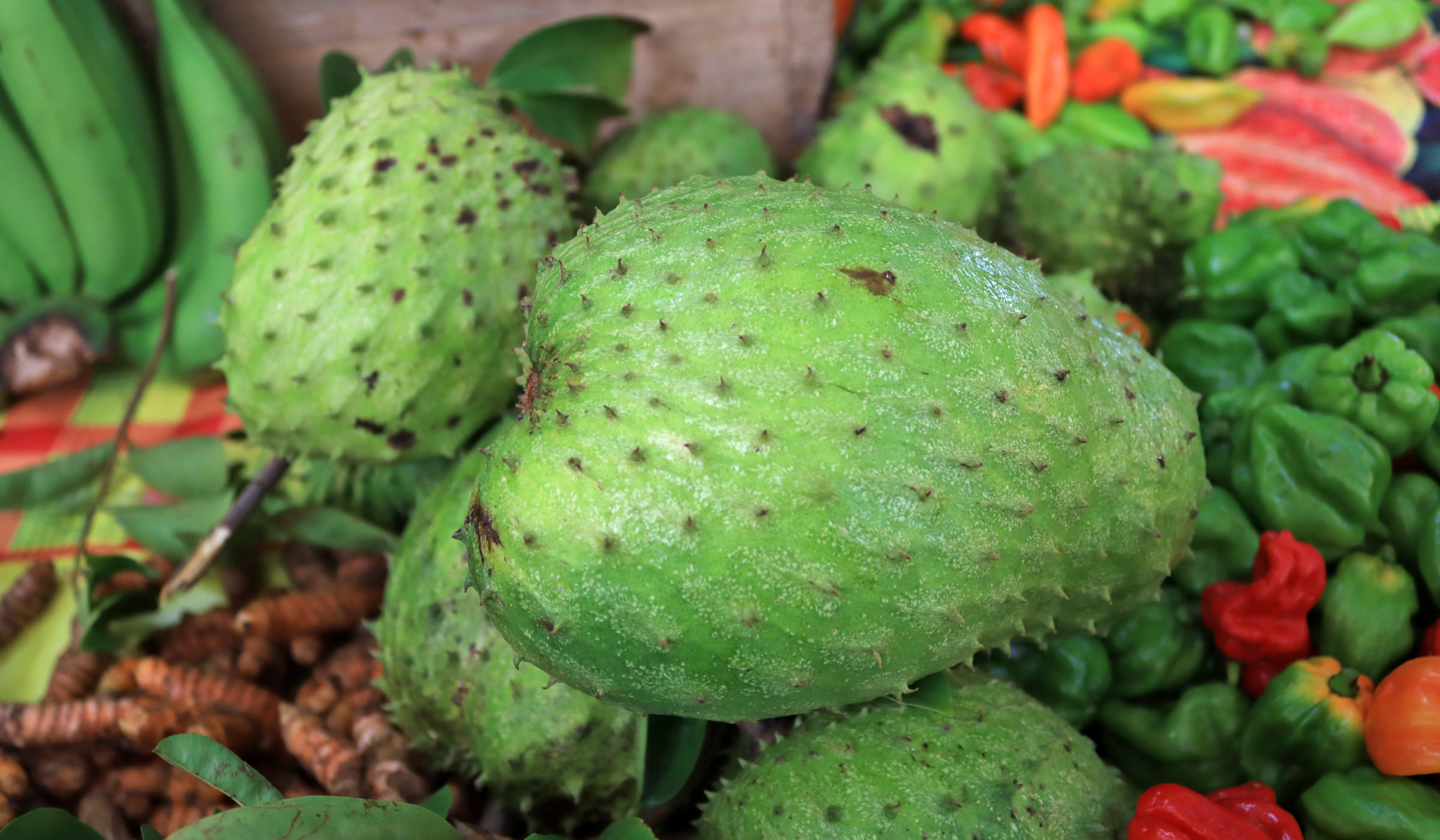
The fruit is quite large, heart‑shaped, green, and covered with small, soft conical spines. The pulp is very white and sweet, containing flat black seeds. When fully ripe, it can measure 15 to 35 cm in length, 10 to 20 cm in diameter, and weigh up to 3 kg.
There is no specific season; soursop can be found year‑round.
Medicinal properties
Soursop is recommended for sleep disorders, heart issues, parasitic diseases, and ectoparasitoses. A study conducted in vitro in 2011 and on mice showed promising results in the fight against breast cancer.
Soursop also has diuretic properties.
Although research is not yet conclusive, it appears that soursop may accelerate Parkinsonian symptoms in individuals with the disease due to its high concentration of annonacin. It is therefore not recommended for people with Parkinson’s disease.
Uses
Soursop is eaten raw. It can also be used to make nectar juice, ice cream, sorbets, and jams.


