

Martinique enters the war
Mobilization on the ground
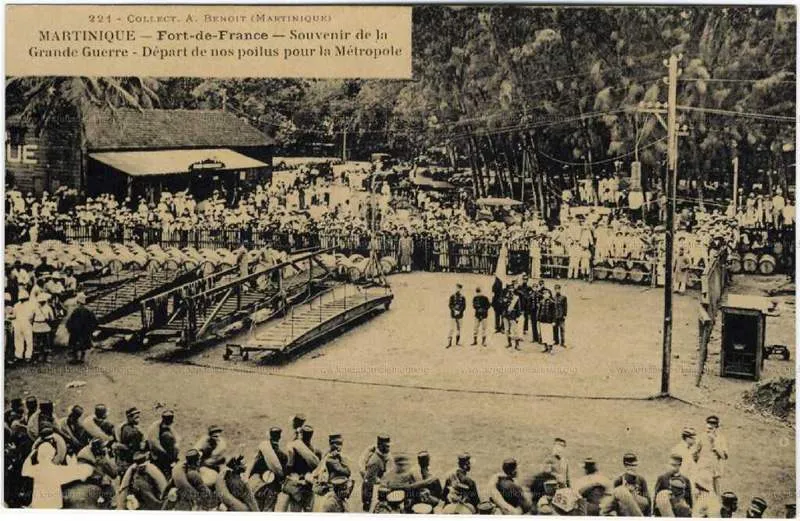
When France ordered its metropolitan troops to mobilize on August 1, the news reached the French West Indies the very next day. In Martinique, the call was received favorably, and many men felt ready to defend the motherland and help it take revenge after the loss of Alsace-Lorraine. Numerous patriotic demonstrations took place in certain towns and in Fort-de-France.
Politicians of the time, at a moment when total assimilation into France was being advocated, encouraged a favorable response to this call from the metropolis.
Military service, which had not been in place until then, was introduced in 1913 for all men for a period of three years. As a result, the men from Martinique who left were behind in their training compared to the French, who had been trained through military service that had been in place for several decades. They did not even know how to hold a weapon when they left for metropolitan France. They were often looked down upon by the French military command, to whom they had been imposed. It was towards the end of the war that they came to be better regarded, due to the length of the war.
Recruitment was carried out by the Draft Board, which, following a census conducted in each municipality, summoned all young men of fighting age, i.e., between 20 and 35 years old. It should be noted that it was not possible to refuse to attend the summons. Anyone who did so risked being imprisoned. Even if they were exempt, it was compulsory to appear before the Draft Board.
A medical examination was carried out to determine whether they were fit for combat and, if so, they were declared BSA (Bon Service Armée, or fit for military service). Those who were not selected were only granted a reprieve and were assigned a job that required them to remain in the colony. After being selected, soldiers underwent two months of training in the countryside or at Place de la Savane, where they learned how to dig trenches.
This short training period was a considerable disadvantage to the Martinicans, who were quickly judged to be underperforming, lacking in stamina, and often ill. It should be noted that many young people were deemed unfit by the Draft Board when, in fact, they were not. This institution, which included relatives of major industrialists, rigged the results in order to keep the workforce on the island.
The first mobilization in 1914 did not concern Martinicans. However, only troops from mainland France. The first conscripts in Martinique after the declaration of mobilization were called up in April 2015, even though some Martinicans were already in mainland France. This late departure can be explained by the fact that no one at the time thought the war would last more than three months and that it did not seem appropriate to bring in forces from the colonies for such a short period.
In addition, those who had already left were suffering terribly from the cold, and the basic training they had received did not encourage them to leave. The call-up was compulsory for all men between the ages of 19 and 45, and refusal could result in a prison sentence. Few chose to refuse mobilization, but those who did fled to other Caribbean islands or claimed to have more than five children, a condition that could prevent them from being sent to mainland France.
In fact, mobilization did not apply to sick people, fathers with more than five children, or certain people retained by industrialists. However, those who left were happy because they were escaping poverty and had the opportunity to travel and discover Paris.
The politicians of the time, fervent advocates of total assimilation into France, expressed their pride in seeing the island so mobilized and boasted proudly that it was the colony that had provided France with the most soldiers. Jules Monnerot, a socialist leader, declared in his Bulletin d'Histoire:
Thus Martinique and all the old French territories whose contribution to the work of National Defense had been too disdainfully refused will have the supreme honor of contributing, like all parts of republican France, to repelling the invader.
Martinique had finally obtained the right to pay the “blood tax,” which elected officials had been demanding for more than 20 years.
In fact, a real recruitment system had been put in place. In each municipality, a census was taken of the male population aged between 20 and 35. They were then summoned for a medical examination called the “révision.” Following this, they were either declared fit for service (BSA, or Bon Service Armée), those who failed were sent home, and a third option was that some were granted a deferment if they were undergoing training that required them to remain on the island.
Those who were accepted were often thin, as many Martinicans suffered from malnutrition at the time. They were trained in the countryside, where they were taught how to dig trenches and how to fight and survive in them.
Many managed to be exempted from mobilization under pressure from the Békés, who would not have had enough labor in the fields, while rum and sugar were in high demand during the war. Thus, it is estimated that only 18% of “mobilizable” men were recruited.
In total, nearly 9,000 Martinicans were mobilized, and several thousand more could have been mobilized if the draft board's tests had not been rigged to keep men on the island.