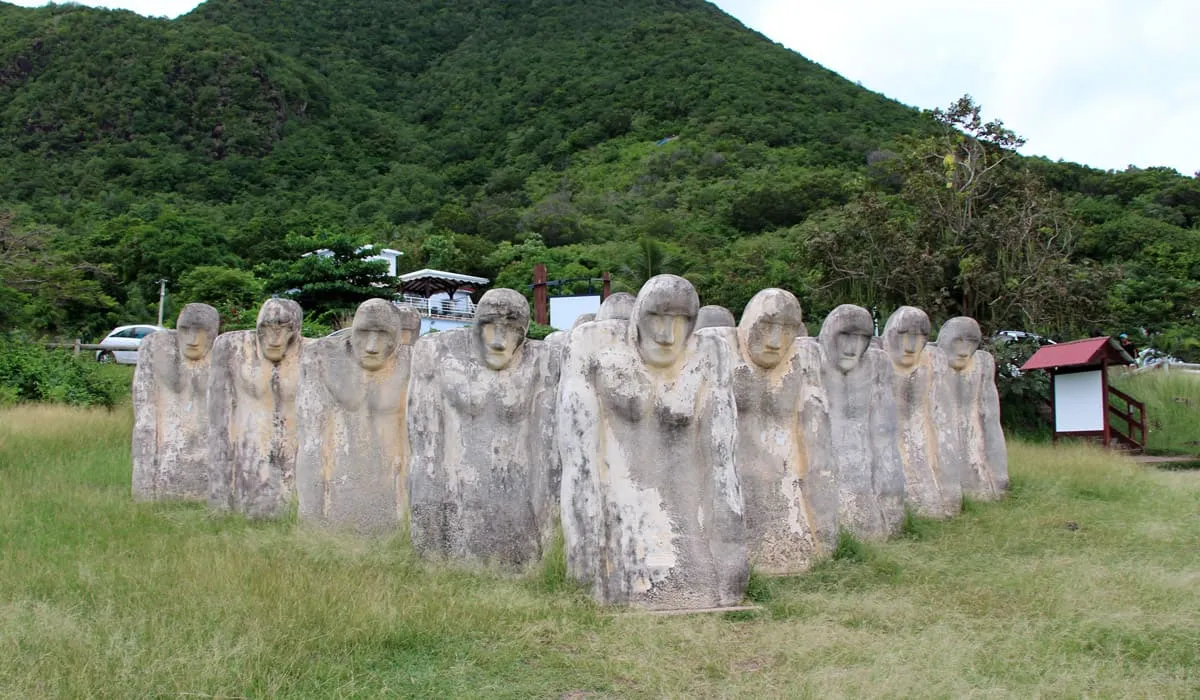
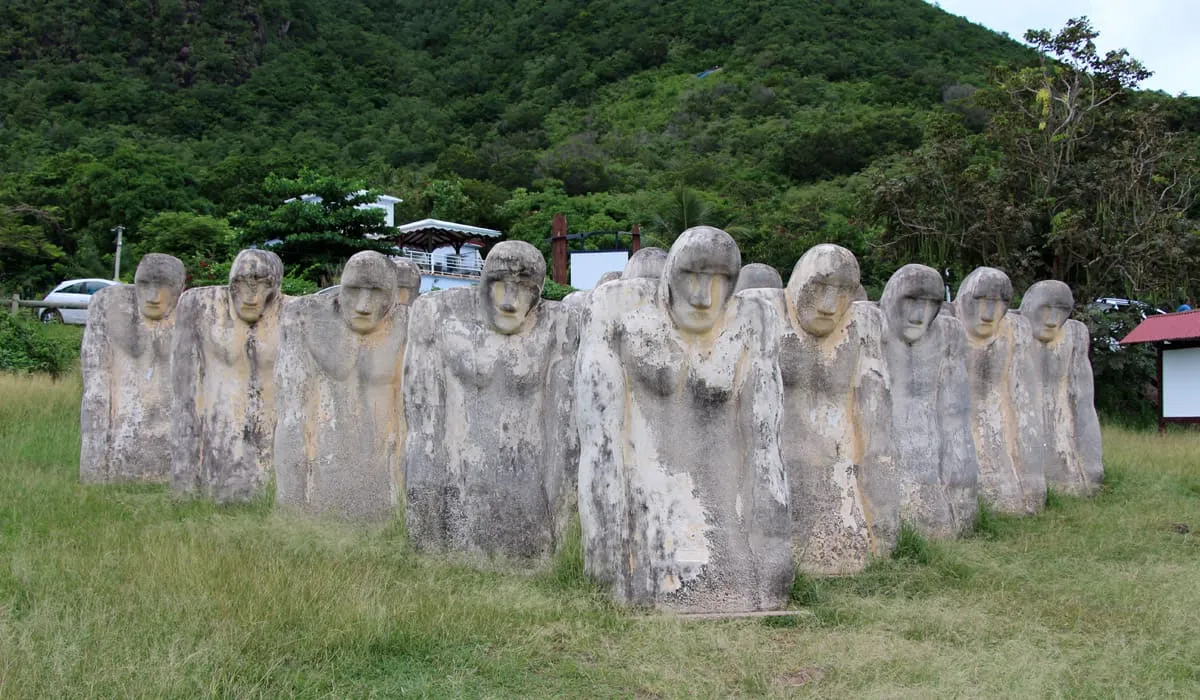
Cap 110 is a memorial erected in remembrance of slavery. It was built at Anse Caffard in 1998, for the 150th anniversary of the abolition of slavery, by Laurent Valère, a Martinican painter and sculptor.
The choice of Anse Caffard is significant. It was near this cove—named after the colon Jean Caffard—that a ship carrying 300 enslaved people crashed onto the coastal rocks during a violent storm on the night of April 8, 1830. Yet at that time, the slave trade had been illegal since 1817.
The ship was completely destroyed, making it impossible to identify its name or origin. Only six bodies were recovered. The sailors were buried in the cemetery, while the enslaved victims were laid to rest near the shore. Eighty‑six captives—26 men and 60 women—survived the wreck and were taken to Fort‑de‑France.
The 15 statues are said to be made of reinforced concrete and whitened with sand from Trinidad and Tobago. Each weighs around four tons and stands 2.5 meters tall.
All of them share the same bowed, sorrowful face, eyes lowered toward the earth and the sea. They represent the anonymous victims of the transatlantic slave trade, which lasted three centuries (from the 17th to the 19th century) between Europe, Africa, and the Americas.
The 15 white concrete figures carry multiple layers of symbolism. White represents mourning in the Caribbean. Their triangular arrangement evokes the triangular trade between Europe, Africa, and the Americas. Their orientation—110° east—points toward the Gulf of Guinea, from where the ship likely originated. The memorial faces the Diamond Rock.