
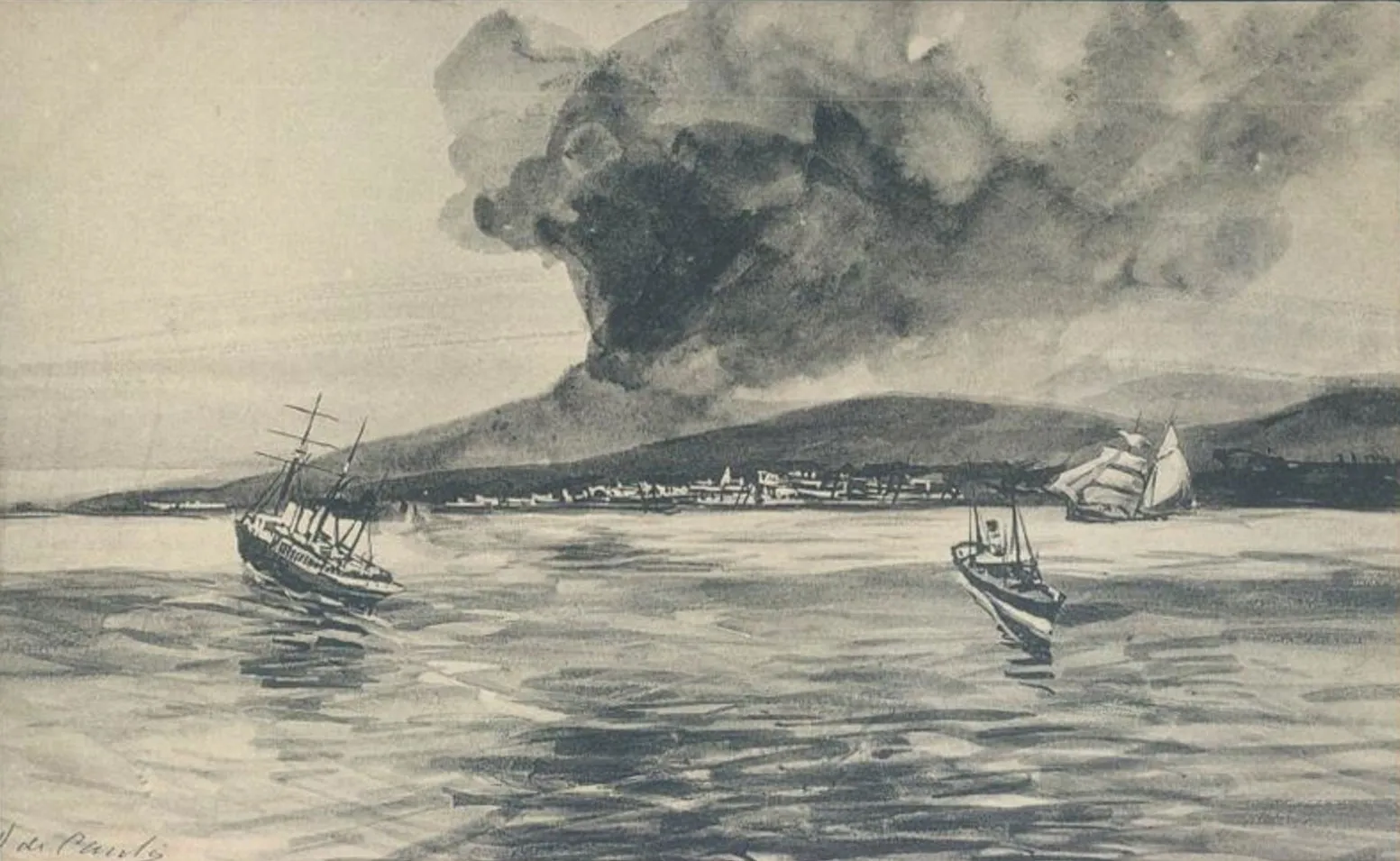
Early signs of the eruption
On the one hand, it could be said that the magma in Pelée had caused a few earthquakes, but on the other hand, the volcano's activity had been increasing at an unusual rate. No one at the time seemed overly alarmed. Some wise men of the time declared, “It's an old man snoring. Nothing to worry about. Just his last gasp.”
In March 1902, the odors became even more nauseating over an area stretching to Prêcheur and Sainte-Philomène, 5 km north of Saint-Pierre. People living on the heights of Mount Pelée who had always drunk the waters of the Rivière Blanche complained that they were developing colic.
On Sunday, March 23, 1902, Louis des Grottes, owner of the Leyritz Plantation, climbed to the top of the mountain and saw several craters in the Étang Sec (summit peak) that were smoking. He wrote: “Today, March 23, the Étang Sec crater is erupting,” without really realizing the drama behind this statement.
During April 1902, it is difficult to say exactly what was happening at the summit of Mount Pelée because of the numerous clouds that obscured the view. The fumes were stronger, more frequent, and more abundant, and they significantly disrupted daily life in the villages on the west coast of the mountain.
On April 10, Abbé Duffau, a priest in Sainte-Philomène, complained to some friends: "I don't know what will become of us. It has been stinking of sulfur for a while now. Life is unbearable." Around the middle of the month, the ground rumbled like thunder, and whitish smoke escaped near La Soufrière.
One person was intrigued by what was happening in Saint-Pierre: Gaston Landes, a high school science teacher and one of the town's intellectuals. He had written a brochure on Martinique for the Great Exhibition in Paris in 1900. He was not an expert on volcanic eruptions, but he conscientiously tried to interpret the course of events with his general scientific knowledge about volcanoes.
On Sunday, April 20, he climbed to the summit to see for himself what was happening. He noticed two new openings that had developed at the crater. He did not have sufficient scientific knowledge to realize the implications.
On April 22 at 2:03 p.m., a small earthquake caused a landslide at sea level northwest of Mount Pelée, the main consequence of which was the rupture of the telegraph cable between Martinique and Guadeloupe.
On April 23, starting at 8:00 a.m., three additional earthquakes shook the sides of the mountain. Clara Prentiss, wife of the American Consul in Saint-Pierre, wrote to her sister living in the United States: “We heard three distinct tremors. The first was strong, the second and third were so strong that the dishes fell from the shelves and the house was completely turned upside down.”