
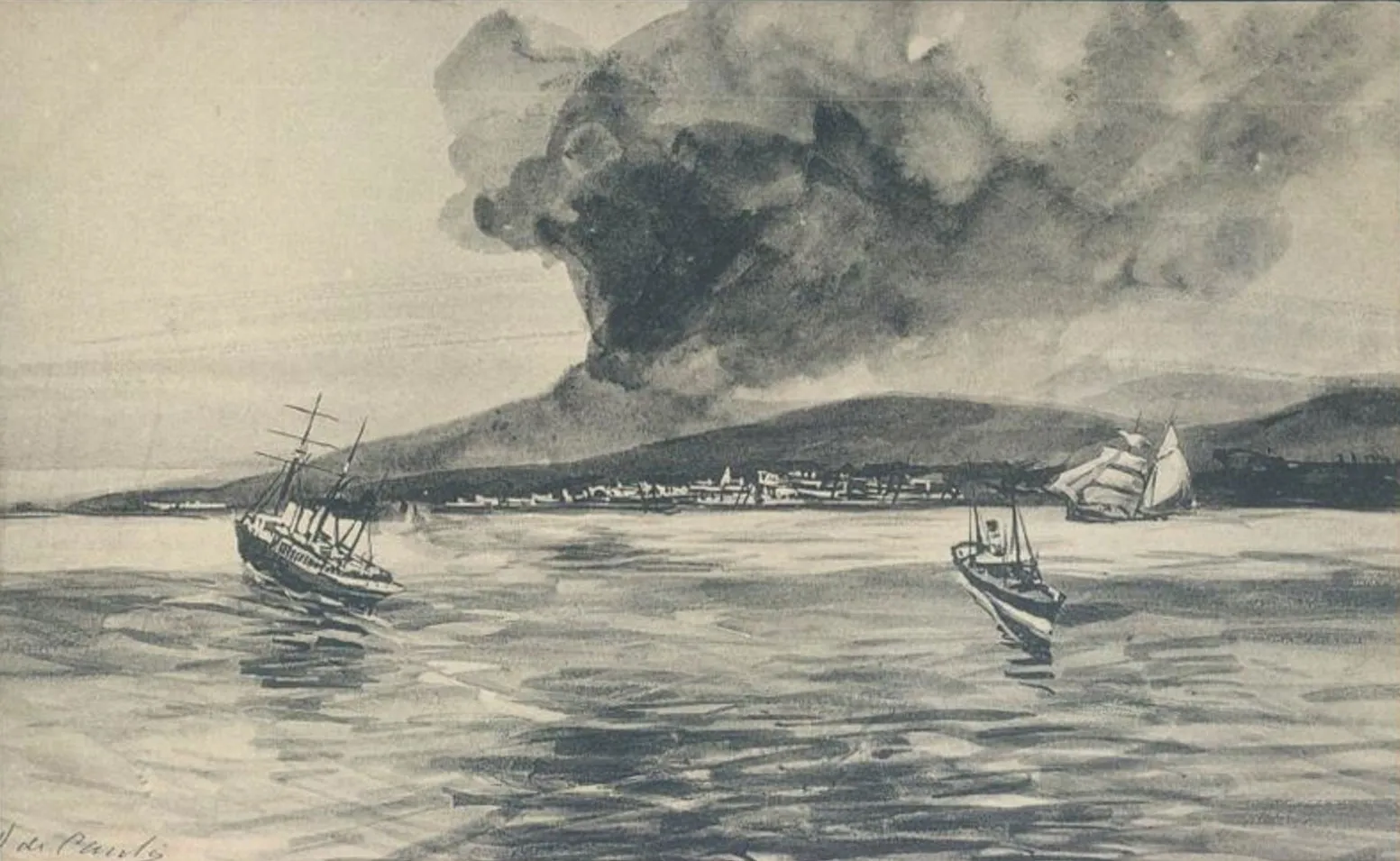
Rebuilt but...: Saint-Pierre today
After the eruption of Mount Pelée in 1902, many questions arose because Saint-Pierre was the capital of Martinique. Should a city that could be destroyed again be rebuilt on the ashes of the eruption? Should Fort-de-France, the administrative capital of Martinique since 1692, become the new capital of the colony? How would Martinique recover after losing its economic and social heart?
Opinions differed greatly on some of these questions. As for the question of whether Martinique will recover, the island will not take long to get back on its feet. International aid has been very significant. Shipments are being sent from all over to help the population meet their basic needs. The two other French colonies in the area, Guadeloupe and French Guiana, are offering to take in the people who lost everything in the disaster.
The metropolis sent various material and physical resources to help the population overcome this terrible ordeal. There was widespread looting. In response, the metropolis called for a national looting of the sites. The state then delegated a commission to recover the jewelry found on the corpses, with the promise of returning it to the families of the deceased, but the promise was not kept. People come to Saint-Pierre to recover fountains, search for marble, take statues, and seize cannons.
Regarding the reconstruction of Saint-Pierre, the New York Herald correspondent, in an interview with Admiral Sevran, who commands the Tagus, states:
The town of Saint-Pierre should never be rebuilt, as the danger posed by Mount Pelée could continue for centuries. Nor should Fort-de-France be allowed to expand further. I will use my influence to have another town built on the southeast coast of the island, either at La Trinité or La Caravelle, which should become the capital of the colony.
At that time, it seemed obvious that the colony's capital needed to be moved to a safe location, sheltered from the potential wrath of the volcano. However, given the urgent need to quickly reorganize life in Martinique and revive the badly damaged economy, Fort-de-France, which already had a port, seemed the logical choice.
Saint-Pierre was stripped of its title as capital of the colony and never regained this predominant status. Today, it is the seat of a sub-prefecture of Martinique and has a branch of the Martinique Chamber of Commerce. For years, the city remained in ruins. Saint-Pierre was abandoned in its role as the economic capital of the colony in favor of its great rival, Fort-de-France.
It even fell under the law of February 15, 1910, which removed it from the map of French municipalities. Its administration was entrusted to the neighboring town of Carbet. This 1910 law authorized the receiving municipality to sell the assets of the abolished municipality and to keep the proceeds from its liquidation. As a result, Saint-Pierre lost a large part of its rich archaeological heritage.
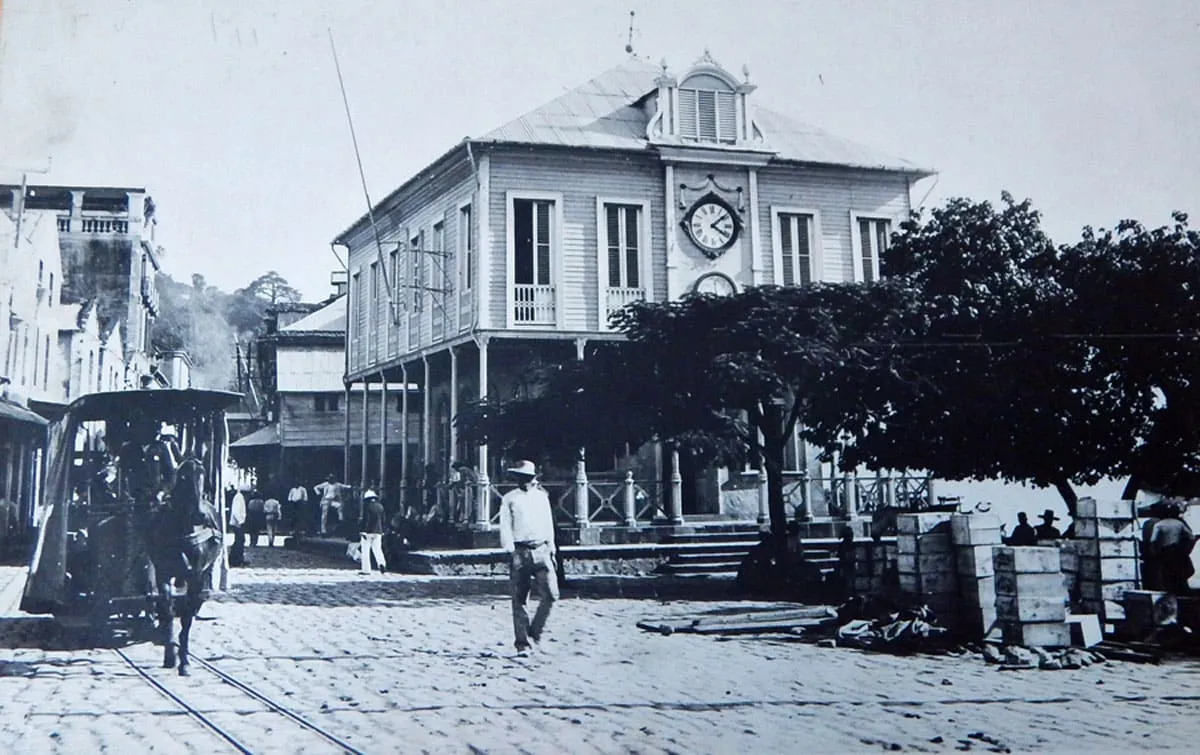
It was not until 1923 that Saint-Pierre rose from the ashes. It was gradually rebuilt, sometimes preserving the buildings as they were (the Chamber of Commerce, rebuilt identically, is currently one of the most beautiful architectural works on the island (see photo), the former Cathedral of Mouillage) or in a more modern style (private homes).
The population gradually returned to settle in the city, but never reached the 28,000 inhabitants who lived there on the eve of the 1902 eruption. The city has grown from 3,000 inhabitants in 1923 to 4,122 today.
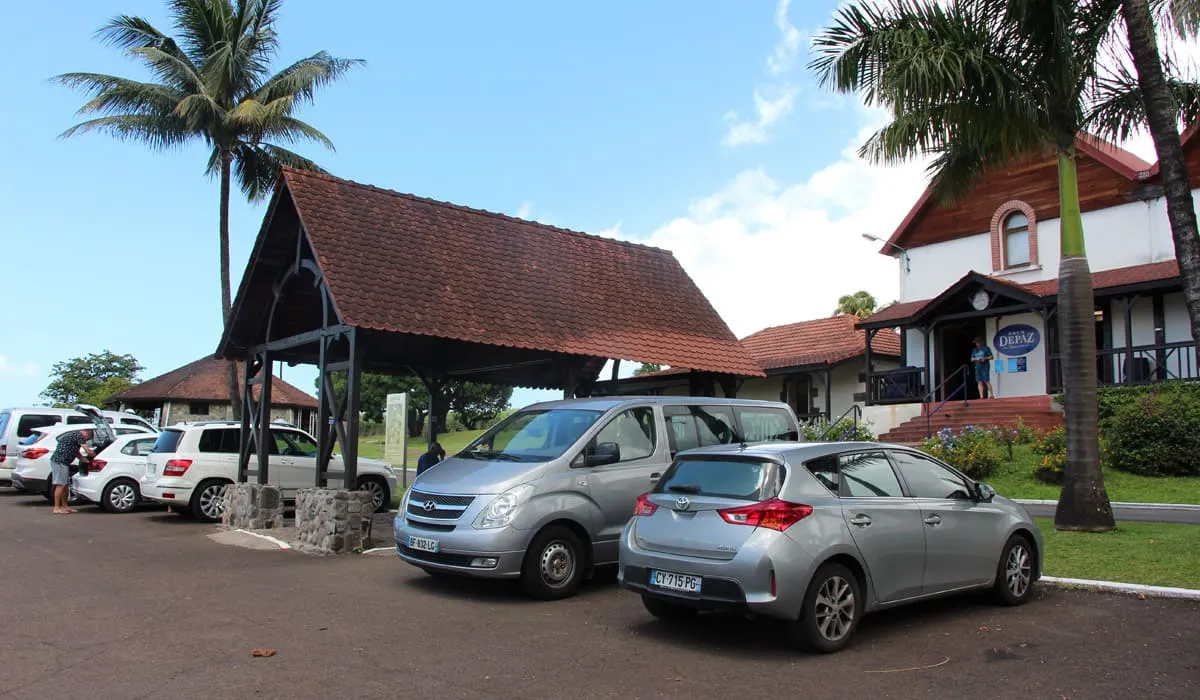
Economic activity gradually resumed, and Victor Depaz, a member of the Depaz family who lived at Habitation Perinelle, returned from Bordeaux where he had been studying. An orphan, he had lost his entire family in the 1902 eruption. He was determined to rebuild the old house where he had lived during his youth. He bought back the former lands of Habitation Pécou, where he rebuilt his old house (Château Depaz) identically and founded the Depaz distillery, which produces rum.
It is still in operation today and produces high-quality rum. He financed various reconstruction projects in the town of Saint-Pierre, including those of the former Mouillage Cathedral.
The ruins of the most memorable sites (Cyparis' cell (a prisoner who survived the eruption), the ancient theater, the fort's church, the bridge over the Roxelane (which withstood the eruption), the ruins of Le Figuier (former warehouses and stores) and Rue Monte au Ciel) are preserved as part of the town's heritage and maintained year after year as a collective reminder of this extraordinary disaster. In 1990, the entire town was designated a Town of Art and History by the Ministry of Culture and Communication.
Today, Saint-Pierre's economy is based mainly on tourism, particularly diving, as the port has many shipwrecks.
The Martinican proverb “Tout couyon mô Saint-piè” (All the idiots died in Saint-Pierre) seems very naive when we consider the grandeur of Saint-Pierre at the time. No one thought that this city, created on the model of European cities and rivaling any city in the world in terms of its originality, buildings, wealth, and organization, could be destroyed in a matter of minutes.
Saint-Pierre was the success story of French colonization. France had managed to export its model and supplant the great British Empire. In fact, Saint-Pierre aroused jealousy even among European cities. Fort-de-France was the administrative capital at the time, but why flee and take refuge there when you were living in optimal conditions?
Moreover, did the elites, more concerned with the upcoming legislative elections, not downplay the situation?
Were researchers at the time interested in the rumblings, the numerous earthquakes, or the white steam escaping from the peaks of Mount Pelée?
Today, it is difficult to realize, but the story of Saint-Pierre is a precursor to the story of the Titanic, which would sink a few years later. After all, wasn't Saint-Pierre also unshakable?