Moulin de Val d'Or

The Moulin du Val d'Or (Val d'Or mill) is one of the many witnesses to Martinique's slave-owning past. It was erected in the 18th century on the Habitation du Val d'Or to facilitate the crushing of sugar cane. With a height of 18 meters, it was the central element of the old plantation and the point of connection between the plantation, i.e. the place of the sugar production, and the pier of the seaside from where the goods were transported.

Concerning its operation, the mill was operated by mules and was a symbol of the mechanical technology of the time to produce sugar cane. Later, it was completely restored in order to repair the walls, the roof and the carousel mechanism. It continued to be used even after the installation of the steam engine in 1882. The construction of the Marin factory will cause its usage to decrease until it is no longer used.

The Val d'Or mill is to this day, the only animal mill still in use in the Caribbean. It is one of the sites of the Parc Naturel Régional de la Martinique (Regional Natural Park of Martinique). It is classified today as a Historical Monument.

During the guided tours, you will be able to discover the remains of the sugar factory nearby and attend an animation where donkey-makers and guides will make you discover the techniques of the time of crushing of the cane.

Habitation Beauséjour

Habitation Beauséjour is located at the northern tip of Martinique, in the commune of Grand-Rivière. Built in the 18th century, the estate witnessed the evolution of various crops during the period of slavery. Cacao, sugarcane, banana, and later sugarcane again were cultivated successively on its lands.

Around the main house, which dates from 1820, stand two additional buildings: the “Senator’s Pavilion,” built as the office of Amédée Knight, senator of Martinique who lived there, and another structure that served as a storage area, water house, and stable. Much farther downhill lies the “rue cases-nègres,” which was the living area for enslaved people and later for agricultural workers.

The first owner of the estate was Chambert Anthoine, known as La Rivière, originally from Agde (Hérault), according to documents from 1671. At that time, the property covered about 150 hectares. In 1680, the estate was home to the master, his wife, their two children, and 80 enslaved Africans. Until 1928, nine different owners succeeded one another, including the Knight family, whose patriarch Amédée Alexis Augustin Knight was a descendant of a Black man born in Martinique. Knight, an engineer trained at the École Centrale de Paris, became senator of Martinique in 1899.

A planter and distiller in Saint-Pierre, he acquired the land in the early 20th century, at a time when the sugar industry was in crisis and plantation bankruptcies were common. Despite this, the estate experienced remarkable prosperity under his management. Its surface area expanded from 136 to 285 hectares, and he established a distillery that produced a high‑quality rum, “H.B.S. rum,” which won a gold medal at the Colonial Exhibition in Paris in 1932.

It was also during this period, between 1900 and 1912, that the estate took the name Beauséjour. When Amédée Knight’s heirs sold the property in 1928 to the “béké” Pierre François Honoré Louis de Lucy de Fossarieu, it had grown by another 50 hectares. Sugarcane cultivation and rum production continued, while cacao declined in favor of secondary crops such as corn, beans, and sweet potato. After the Second World War, banana cultivation took over, and rum production ceased in 1958.

For several years, banana was the estate’s main crop, until sugarcane once again became predominant in more recent times.

The estate was listed in the French Register of Historic Monuments in September 1996. It now produces a high‑quality rum that visitors can taste during the tour.

To reach the estate from Fort‑de‑France, follow the N3 to Ajoupa‑Bouillon, then take the N1 toward Basse‑Pointe, Macouba, and Grand‑Rivière. Before entering the village, turn left.

Aubéry Castle

The Aubéry Castle, formerly known as Maison Rivail, is a construction dating from the early 20th century. It belonged to Eugène Aubéry (1879–1942). Eugène Aubéry was a white man of modest origins. His marriage to Berthe Hayot, daughter of Gabriel Hayot, a major landowner, propelled him into the highest economic circles.

He first served as administrator of the central factory of Lareinty and later became General Councillor of Lamentin.

Built between 1928 and 1931, the four‑story castle, with its 30 rooms, reflects the status of its wealthy landowner. To enhance the prestige of the building, architects Balesco and Volpi favored a neoclassical style, as evidenced by the porch leading to a double circular staircase, whose mosaic bears the initials of the owner, “AE, year 1930.”

Eugène Aubéry was implicated in the assassination of André Aliker on January 12, 1934, of which he was very likely the instigator. In 1942, upon his death, his wife and eight children left Maison Rivail.

The castle then became the property of the General Council of Martinique. In 1954, it housed the École Normale and later the agricultural school.

Abandoned thereafter, it was sold for a symbolic one franc to the municipality of Ducos in 1987. The building has been protected as a Historic Monument since December 31, 1992.

As its materials deteriorated under the effects of the climate, restoration was necessary to return the edifice to its former glory.

It is located in the Croix-Rivail district, near the old François road (RN6). It is not currently open to visitors due to ongoing works.

Sacré Cœur de Balata

The Sacré‑Cœur de Balata Church was built in 1915 by the French architect Wulffleff. Monsignor Lequien ordered its construction to accommodate the population displaced from Saint‑Pierre after the 1902 volcanic eruption.

Located on the heights of Fort‑de‑France along the Route de la Trace, in the Balata district, it sits in a humid area that borders the island’s rainforest.

The Balata Church is a replica of the Sacré‑Cœur Basilica in Montmartre.

Photo gallery
Sacré‑Cœur de Balata Church

Habitation la Sucrerie

Habitation La Sucrerie des Anses-d’Arlet is a beautiful estate house dating back to the late 18th century, bearing witness to the industrial history of the Hayot family. Today, it belongs to the Hayot Group, along with Habitation Pécoul and Habitation Clément.

In 1788, Jean-François Hayot left his coffee plantation in Saint-Esprit and purchased La Sucrerie, which was then the most prominent estate in the Anses-d’Arlet area. By 1845, his heir Michel Hayot—mayor of the southern commune (Anses-d’Arlet, Le Diamant, Sainte-Luce)—turned toward sugarcane cultivation in the context of the Industrial Revolution.

The mid-19th-century acquisition of Habitation Poterie and neighboring properties in Trois-Îlets led to industrial diversification, including the production of terracotta building materials such as bricks and tiles. These estates also cultivated sugarcane, which was processed at the Pointe Simon factory (now the Fort-de-France taxi terminal).

A pivotal moment came in 1868 when Octave Hayot (1843–1892) was sent by his father, Louis Hayot, to the newly established Usine du François to work alongside Émile Bougenot, a French mechanical engineer who had come to Martinique to develop a new generation of factories. Under Bougenot’s guidance, Octave learned both the industrial techniques of sugar production and the workings of a modern, shareholder-based enterprise.

This fusion of technical innovation and local production capacity sparked a major industrial success. At the end of 1868, Octave Hayot gathered several planters from the Rivière-Salée region—starting with his family’s estates in Trois-Îlets—to found, with Bougenot’s help, the Central Factory of Petit-Bourg on Habitation Génipa.

In the following years, competition among factory owners led the Hayot family to take control of neighboring estates to secure the factory’s supply chain and long-term viability. Octave Hayot is credited with initiating the agricultural development of the Rivière-Salée plain, which had previously been considered unsuitable for farming due to its marshy terrain. He died prematurely in 1892, and his relatives took over the factory’s management during a pivotal period in Martinique’s history.

Later, the eruption of Mount Pelée caused the deaths of many merchants, positioning factory owners as key players in the island’s economy. Descendants such as Joseph, Simon, Saint-Michel, Léon, and Yves Hayot played a major role in the sugar industry, managing numerous factories in Le Robert, Le François, and Lareinty until the late 1960s, when the sugar crisis brought an end to cane sugar production.

The family then shifted its focus to consumer goods retail, founding the Hayot Group, which now owns several stores and businesses across the island.

To get there, take the D7 road to the entrance of the Anses-d’Arlet village. The estate is located at the intersection of the D7 and D37. You’ll need to park your vehicle at the village entrance.

Saint-Etienne Church

The Church of Saint-Étienne of Le Marin was built in 1766 using cut stone. It stands out from the island's other churches thanks to its bell tower, located right next to the building. Its architecture is in the Jesuit style.

The interior of the church is just as surprising as the exterior. The framework resembles the hull of an overturned boat. In the choir is a magnificent white marble altar which, according to legend, was intended for the cathedral in Lima, Peru, but was shipwrecked not far from the coast of Le Marin.

It was donated by François Cornet, a wealthy resident of the town, thanks to a bequest of 6,000 pounds in 1769. He had already donated the statues of the Virgin Mary, the Child Jesus, and Saint Stephen to the church.

Photo gallery
Saint-Etienne Church

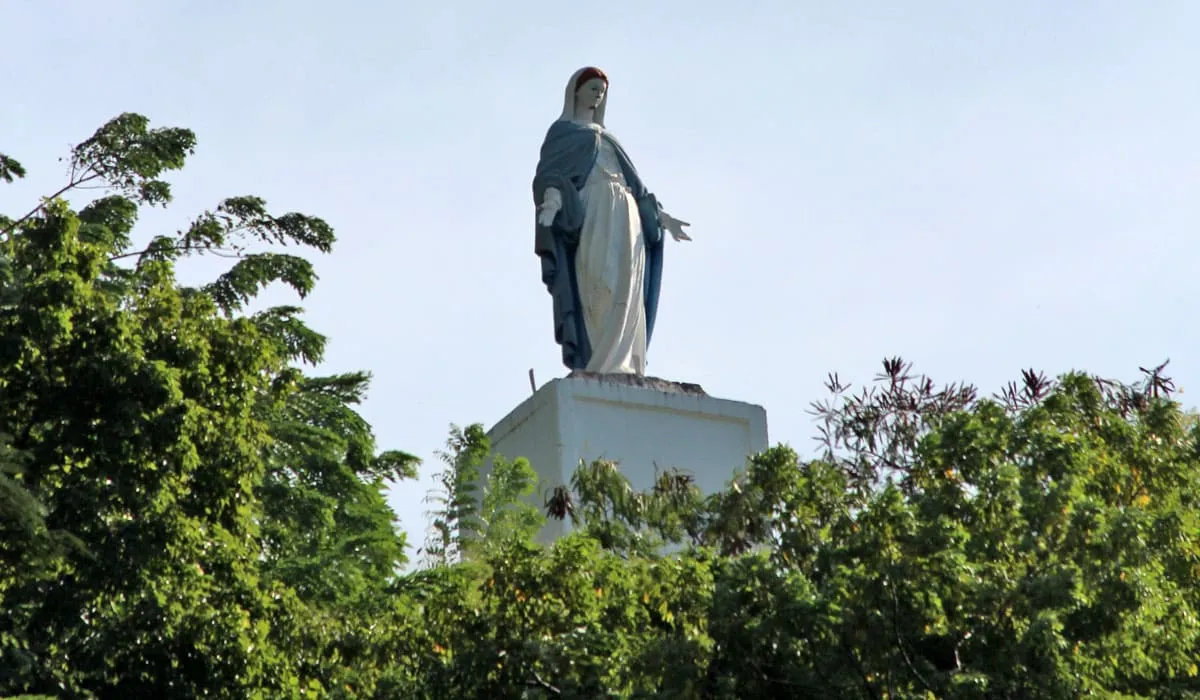
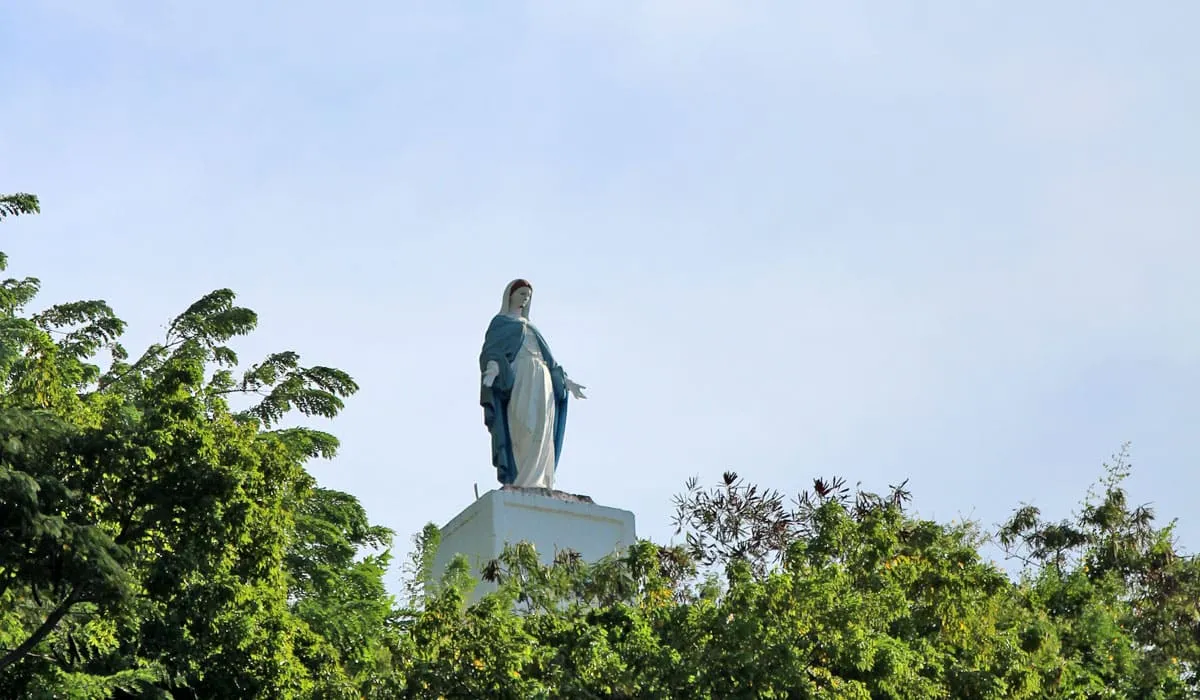
Virgin of the Sailors

The Vierge des Marins (Virgin of the sailors) was erected in 1870. At this time, it was at the time more than 8 tons and was 7km of Mount Pelee. 

It was reversed face against the ground during the eruption of Mount Pelee in 1902, but was not destroyed! For cons, the base could not resist the devastating lava from the volcano. It was restored in 1921.

It is also known as Notre-Dame du Bon Port and still watches over the city of Saint-Pierre.

To see it, climb on the road that crosses the D1 right (direction Fonds-Saint-Denis) just after the cemetery. At the top, turn right down the road and finish the distance on foot.

Photo gallery
Vierge des Marins (Virgin of the sailors)

Château Dubuc

Château Dubuc (Dubuc Castle) was once the possession of the Dubuc family, a wealthy lineage from Dieppe in Normandy who settled in the town of Trinité in the mid‑17th century.

In 1657, Pierre Dubuc, a Norman, arrived in Martinique. After leading several successful expeditions against the Carib Indians, he was granted by other settlers a concession in the area of Trinité and Tartane, where he settled in 1671 and built his power.

Balthazar, his younger brother, established himself at the Caravelle on the Spoutourne Plantation. His son, Louis Dubuc du Galion, later built a residence initially called Habitation Caravelle, which eventually became known as Château Dubuc.

The plantation was not only a site of sugar production but also a hub for smuggling and the trafficking of enslaved people. The presence of warehouses, safes, and wharves in this isolated location strongly suggests that illicit trade was carried out there.

By 1770, the Château Dubuc was gradually abandoned, following the devastating cyclone of 1766 and the mismanagement caused by the Dubuc family’s involvement in various battles against the English.

Today, the castle lies in ruins and forms part of the nature reserve managed by the Parc Naturel Régional de la Martinique. It is a secure site and has been listed as a historical monument since 1991. Château Dubuc ranks among the three most visited sites in Martinique. In addition to the ruins, a micro‑museum recounts the troubled history of this place.

Photo gallery
Ruins of Dubuc Castle
Sign of Dubuc Castle

Observatoire du Morne des Cadets

The Montagne Pelée Volcanological Observatory, located on Morne des Cadets, is responsible for monitoring volcanic and seismic activity and conducting related research. After the 1902 eruption, Professor Alfred Lacroix had a small hut built on Morne des Cadets to serve as an observatory.

He worked there with a few geophysical measuring instruments, but as the volcano showed no further signs of activity, the decision was made to stop the observations. Four years later, the major 1929 eruption caused no casualties but did result in material damage.

A permanent observatory was then built and inaugurated on Morne Moustin, facing the historic installation on Morne des Cadets, from which it inherited its name.

Today, the observatory monitors not only the volcano but also the island’s subsurface seismic activity.

An information and exhibition room is open to the public during the observatory’s visiting hours.

The site has been listed as a Historic Monument since 2012.

Photo gallery
Observatoire du Morne des Cadets

Maison du Bagnard

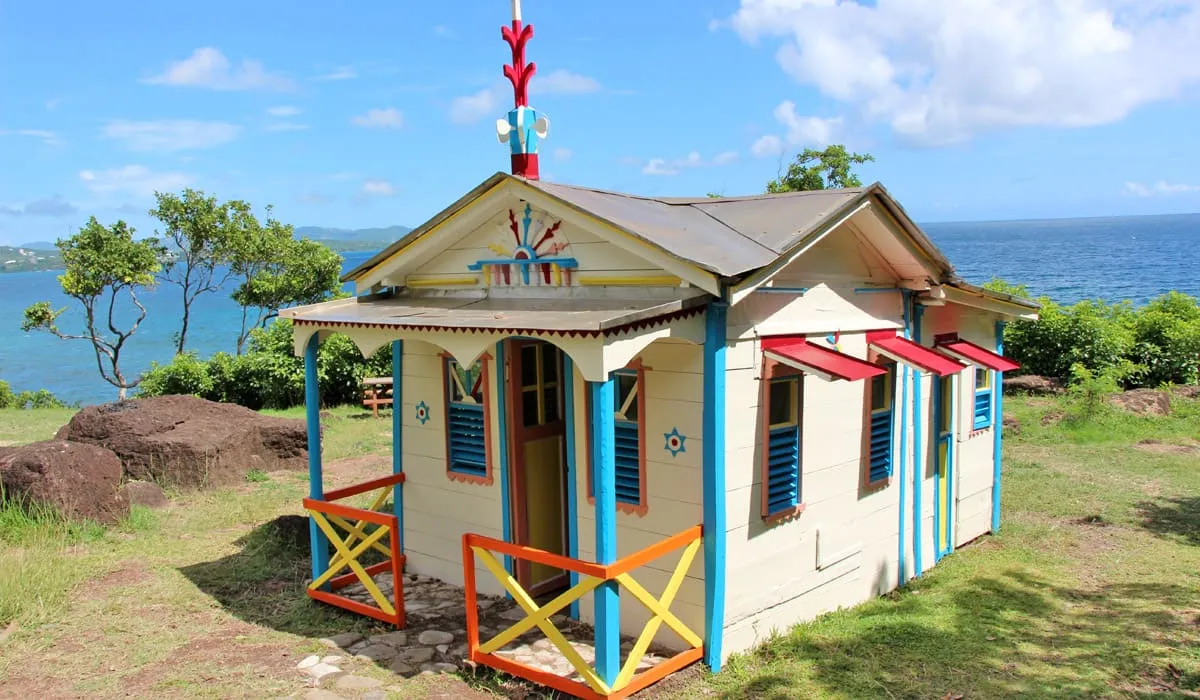
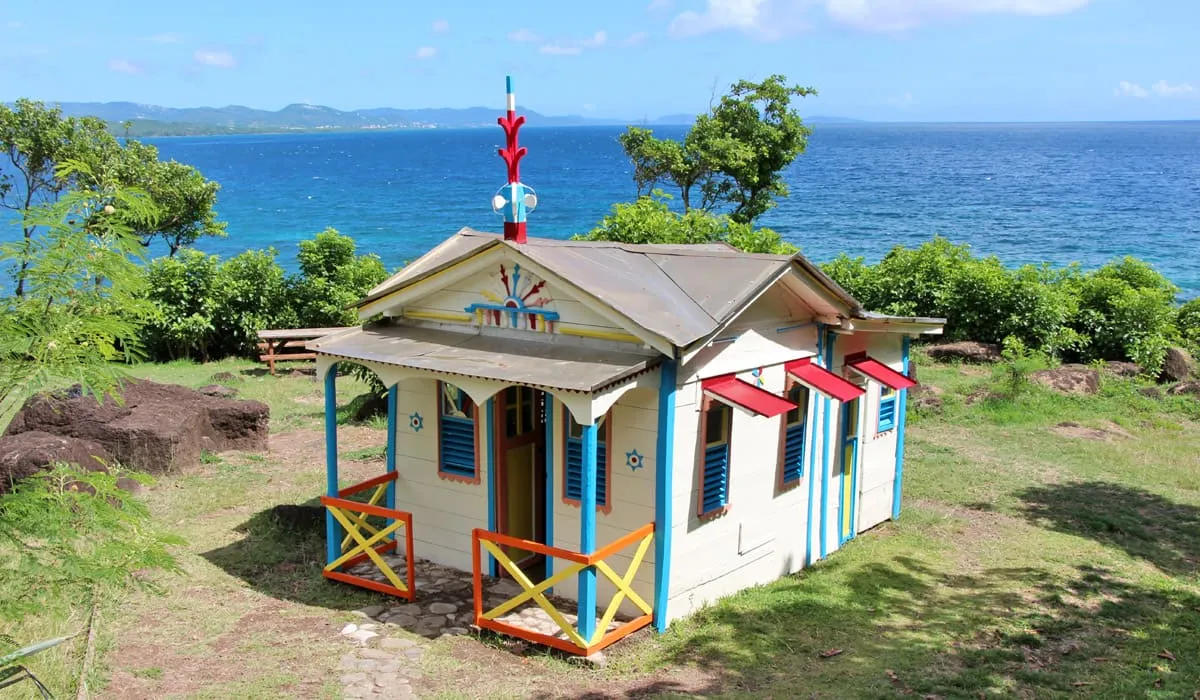
The Maison du Bagnard is a house built by Médard Aribot, a Martiniquan sculptor, upon his return from the penal colony in 1960. He is said to have lived there until his death in 1973. It is an ornamented wooden house, painted white and blue, facing the Rocher du Diamant.

Médard Aribot was a renowned and talented sculptor. He was reportedly sentenced to life at the penal colony. Several explanations are given for the reasons behind his conviction. According to local accounts, the cause was his sculpture of Colonel Coppens, which was brandished and mocked by the crowd during an electoral riot in 1925.

Colonel Coppens, whose real name was Maurice de Coppens, was the owner of a sugar factory in Le Diamant who, in 1925, preferred to have the crowd fired upon rather than risk losing the election. Several people were killed, including Colonel Coppens himself during the riot.

Another “official” explanation attributes Aribot’s conviction to numerous thefts he was said to have committed. After several years in the penal colony in French Guiana, he was released in 1945 following the definitive closure of the penal camps. He returned to Martinique in 1953 and is believed to have lived in the Maison du Bagnard until his death in 1973.

The Maison du Bagnard will soon undergo renovation after winning a fundraising campaign dedicated to its restoration. It is listed as a Historic Monument.

Photo gallery
Maison du Bagnard
Maison du Bagnard
Maison du Bagnard
Maison du Bagnard