Nord-Plage

“Nord‑Plage” is a neighborhood on the north Atlantic coast of Martinique, far from the usual “postcard” images. Facing the sea, it is made up of houses darkened by time, some gutted, others in ruins, yet still inhabited despite the dangers of the site.

According to Father Labat, in his Nouveau voyage aux Isles de l’Amérique (1694), the original bourg of Macouba stood in what is now the Nord‑Plage district, right by the sea. At the time, it consisted of only one or two houses — those of the schoolmaster and the surgeon — along with warehouses where residents stored their sugar.

Local authorities have since taken steps to relocate the last families living there, as the cliff overlooking the area could cause severe damage in the event of a cyclone or hurricane. The site is also closely tied to the island’s strong Catholic tradition: the path leading to the neighborhood is used as a Way of the Cross during the Easter period.

According to legend, a grotto found there — said to be a replica of the one in Lourdes — was the site of an apparition of the Virgin Mary. The place still attracts many pilgrims who visit the grotto or walk the Way of the Cross.

A film of the same name was shot in the neighborhood in 2004 and released in French cinemas, starring Pascal Légitimus and Viktor Lazlo.

You can reach Nord‑Plage via the D10. If you are heading toward Grand‑Rivière, follow the D10 toward Basse‑Pointe, and vice versa in the opposite direction — always along the same road.

Photo gallery
Nord Plage
Nord Plage
Nord Plage
Nord Plage
Nord Plage
Nord Plage

Montgérald Habitation

Montgérald Habitation is an old estate house located in Le Marin. The residence was once occupied by the Charron family, one of the wealthiest families of the period. The structure is made of wood and covered with tiles.

In 1869, Montgérald Habitation was built near the central factory of Le Marin. It supplied sugarcane to the factory for nearly a century, until the industrial site eventually closed. The main house, featuring a façade made of composite materials—wood and stone—was built in a “U” shape, a common architectural layout in Martinique.

The Montgérald Habitation estate has been listed as a historical monument since June 3, 1993.

Please note that photography is only permitted from the outside.

Also, be aware that the site can only be visited during the European Heritage Days.

Saint-Etienne Church

The Church of Saint-Étienne of Le Marin was built in 1766 using cut stone. It stands out from the island's other churches thanks to its bell tower, located right next to the building. Its architecture is in the Jesuit style.

The interior of the church is just as surprising as the exterior. The framework resembles the hull of an overturned boat. In the choir is a magnificent white marble altar which, according to legend, was intended for the cathedral in Lima, Peru, but was shipwrecked not far from the coast of Le Marin.

It was donated by François Cornet, a wealthy resident of the town, thanks to a bequest of 6,000 pounds in 1769. He had already donated the statues of the Virgin Mary, the Child Jesus, and Saint Stephen to the church.

Photo gallery
Saint-Etienne Church

Le Mouillage church

Please note that the Church of Mouillage is currently under renovation and the site is temporarily closed to visitors.

The Mouillage district owes its name to the fact that most boats were once moored in front of it. It was the working‑class neighborhood of Saint‑Pierre, where many of the port’s employees lived. Before its destruction in 1902, the Church of Mouillage served as the cathedral of Martinique.

It was known as Notre‑Dame du Bon Port, in honor of the Virgin of the Sailors. The church was built in 1855 by engineers Scheffler and Robinet.

Before the construction of Notre‑Dame‑du‑Bon‑Port, a small neoclassical church built in 1654 by the Dominicans stood on the same site. Around 1851, plans were made to enlarge the building, which had become the cathedral.

The architectural plans were drawn in 1855 by Scheffler, Chief Engineer of the colony of Martinique, and Robinet, Captain of Engineering and Head of Public Works for the Saint‑Pierre district.

Scheffler chose to preserve the neoclassical style already used for the earlier church. Construction lasted several years due to various setbacks.

In 1902, following the eruption of Mount Pelée, the cathedral lost its status to Saint-Louis Cathedral in Fort‑de‑France, which had become the new capital.

In 1920, the church was rebuilt thanks to donations from Victor Depaz and Monsignor Lequien, who had also initiated the construction of the Balata Church.

Today, it is known as Notre‑Dame de l’Assomption Cathedral and remains an important place of worship for the deeply devout Catholic community of Saint‑Pierre. Behind the church lies the Mouillage cemetery and its ossuary, where the remains of the victims of the eruption were gathered.

Photo gallery
Facade of the Mouillage Church
Plaque of the Church of Mouillage
Entrance to the Mouillage Church
Interior of the Mouillage Church

Ruins of Saint-Pierre

Over the years, the town of Saint-Pierre has retained traces of the terrible eruption of Mount Pelee in 1902. The entire town destroyed by the volcano was partly rebuilt on the ruins left behind.

These ruins have either served as the foundations of houses or are still visible in today's landscape. Visiting the ruins of Saint-Pierre is not easy, as there is no real signposting and the local population is not necessarily familiar with the symbols of the ruins.

If you want to visit, ask the elders you meet along the way, who are generally more familiar with the history of the place. Alternatively, visit the local tourist office, where you'll find a map showing the history of the ruins.

If you'd like to visit, ask the elders you meet along the way, as they're usually more familiar with the history of the area. Alternatively, visit the local tourist office, where you'll find a map showing the history of the ruins.

Among the ruins, don't miss symbolic places such as the Cyparis dungeon (a prisoner who survived the eruption), the ruins of the old theater, the fort's church, the bridge over the Roxelane (which withstood the eruption), the ruins of the Fig Tree (former warehouses and stores) ,or the "Monte au Ciel" street.

Photo gallery
Ruins of Saint-Pierre
Cannons from the old fort
Entrance to the ruins of Saint-Pierre
Site information sign
Little Mermaid from the old Saint-Pierre theatre
Street in front of the ruins
Site information sign
Cannons from the old fort
Ruins of Saint-Pierre

Château Dubuc

Château Dubuc (Dubuc Castle) was once the possession of the Dubuc family, a wealthy lineage from Dieppe in Normandy who settled in the town of Trinité in the mid‑17th century.

In 1657, Pierre Dubuc, a Norman, arrived in Martinique. After leading several successful expeditions against the Carib Indians, he was granted by other settlers a concession in the area of Trinité and Tartane, where he settled in 1671 and built his power.

Balthazar, his younger brother, established himself at the Caravelle on the Spoutourne Plantation. His son, Louis Dubuc du Galion, later built a residence initially called Habitation Caravelle, which eventually became known as Château Dubuc.

The plantation was not only a site of sugar production but also a hub for smuggling and the trafficking of enslaved people. The presence of warehouses, safes, and wharves in this isolated location strongly suggests that illicit trade was carried out there.

By 1770, the Château Dubuc was gradually abandoned, following the devastating cyclone of 1766 and the mismanagement caused by the Dubuc family’s involvement in various battles against the English.

Today, the castle lies in ruins and forms part of the nature reserve managed by the Parc Naturel Régional de la Martinique. It is a secure site and has been listed as a historical monument since 1991. Château Dubuc ranks among the three most visited sites in Martinique. In addition to the ruins, a micro‑museum recounts the troubled history of this place.

Photo gallery
Ruins of Dubuc Castle
Sign of Dubuc Castle

Village de la poterie

Since 1783, the Poterie des Trois-Îlets has existed, making it one of the oldest companies in Martinique. The Village de la Poterie is located on the site of a former Jesuit convent established at the end of the 17th century. Its main activity has always been working with clay.

Over the years, the Poterie des Trois-Îlets has expanded the crafts of terracotta, combining industry (production of bricks, tiles, and floor tiles) with craftsmanship (terracotta pottery).

Today, the Village de la Poterie houses many historic structures and authentic Creole cottages occupied by artisans, potters, and shopkeepers, as well as one of the oldest brickworks still operating in France.

Photo gallery
Village de la Poterie Lane
Village de la Poterie
Stores in Village de la Poterie
Clay vases for sale at the pottery
Red bricks
Red bricks

Memorial Cap 110

Cap 110 is a memorial erected in remembrance of slavery. It was built at Anse Caffard in 1998, for the 150th anniversary of the abolition of slavery, by Laurent Valère, a Martinican painter and sculptor.

The choice of Anse Caffard is significant. It was near this cove—named after the colon Jean Caffard—that a ship carrying 300 enslaved people crashed onto the coastal rocks during a violent storm on the night of April 8, 1830. Yet at that time, the slave trade had been illegal since 1817.

The ship was completely destroyed, making it impossible to identify its name or origin. Only six bodies were recovered. The sailors were buried in the cemetery, while the enslaved victims were laid to rest near the shore. Eighty‑six captives—26 men and 60 women—survived the wreck and were taken to Fort‑de‑France.

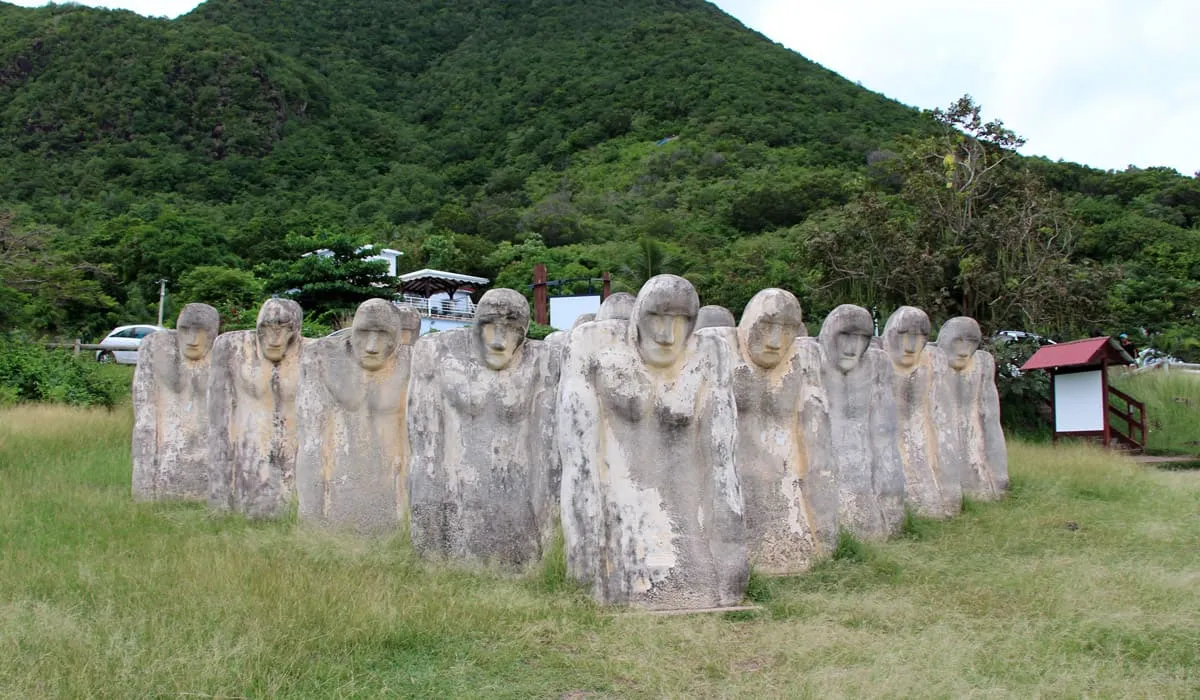
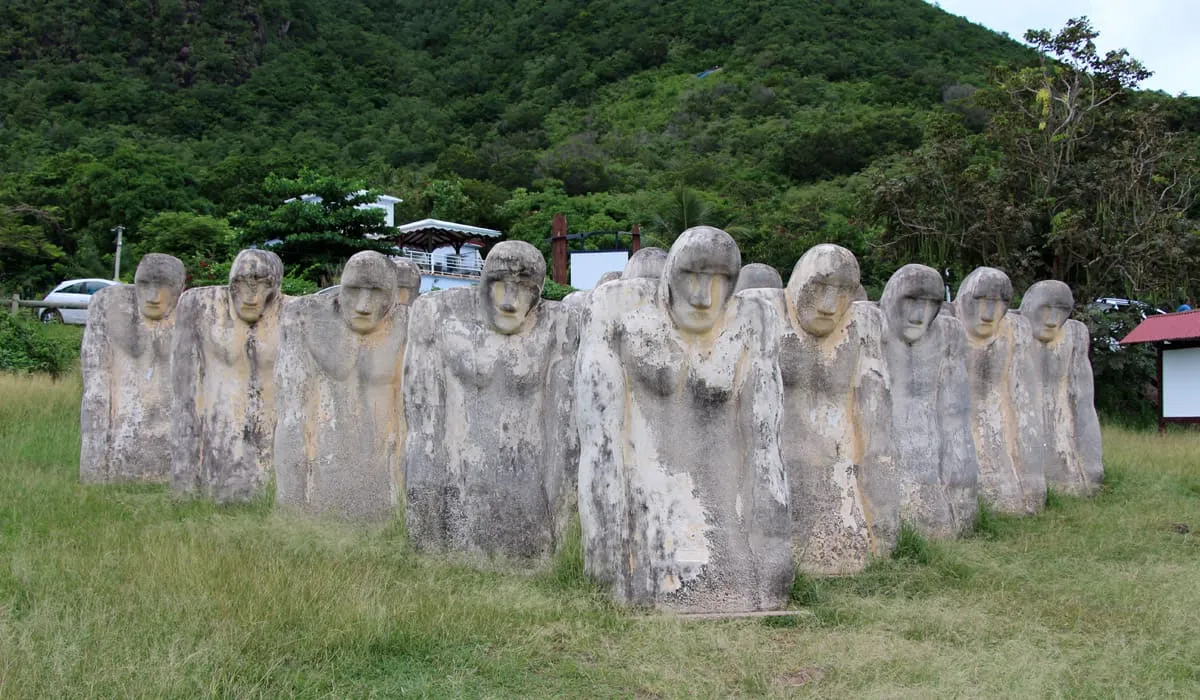
The 15 statues are said to be made of reinforced concrete and whitened with sand from Trinidad and Tobago. Each weighs around four tons and stands 2.5 meters tall.

All of them share the same bowed, sorrowful face, eyes lowered toward the earth and the sea. They represent the anonymous victims of the transatlantic slave trade, which lasted three centuries (from the 17th to the 19th century) between Europe, Africa, and the Americas.

The 15 white concrete figures carry multiple layers of symbolism. White represents mourning in the Caribbean. Their triangular arrangement evokes the triangular trade between Europe, Africa, and the Americas. Their orientation—110° east—points toward the Gulf of Guinea, from where the ship likely originated. The memorial faces the Diamond Rock.

Photo gallery
Memorial Cap 110
Memorial Cap 110
Memorial Cap 110
Memorial Cap 110

Habitation Chalvet

Habitation Chalvet, also known as Habitation La Capot, was a sugar estate in the 18th century that had to reinvent itself following the sugar crisis. Before that, it was a plantation where cacao was cultivated. The remains of several buildings—such as a chimney, sugar mill, and purging house—attest to the site's once-thriving industrial activity.

On this authentic site, now repurposed as a place of leisure, a “Barbette battery” was installed around 1711 to protect the dock and storage facilities. After periods of yam cultivation and greenhouse horticulture, the agricultural activity now focuses mainly on bananas, along with pineapples and sugarcane. In addition to banana production, the estate also features a Creole garden.

Visitors can also explore medicinal plant gardens. Above all, Habitation Chalvet is remembered by locals as the scene of the tragic events of February 1974.

In February 1974, field workers went on strike to demand a five-franc increase in their daily wage from the landowners—known as “Békés,” wealthy descendants of former colonists who have long held agricultural lands in Martinique and still own many of the island’s businesses.

The landowners refused. As days passed, tensions escalated due to the lack of negotiations. The Békés called in the police, followed by armed forces. The latter opened fire on the strikers, killing two agricultural workers: Rénor Ilmany (55 years old) and Georges Marie-Louise (19 years old). Many others were injured.

This event remains deeply rooted in Martinique’s collective memory. It inspired a song by artist Kolo Barst titled Févriyé 74. Each year, the local tourism office organizes a commemoration at the site.
 

Photo gallery
Banana trees at Habitation Chalvet

Anse du Carbet

The beach of Anse du Carbet or Plage du Coin is known for being the one on which Christopher Columbus landed on June 15, 1502. It is also the place that marks the beginning of colonization in Martinique. Indeed, it is the beach on which the first settlers of the island would have landed, including the most famous Pierre d'Esnambuc.

It is a grey sand beach shaded and animated by the activity of fishermen.

The water is calm but there are strong waves due to the wind. This beach has a pontoon.

Several restaurants are located there and you can enjoy local flavors almost with your feet in the water. To get there, head towards the north of Martinique and continue towards Carbet / Saint-Pierre, a little after Neisson, you will see the sign "Plage du Coin" encouraging you to turn left to get there. There is a small parking lot.

Photo gallery
Anse du Carbet / Plage du Coin